Ofcom’s Connected Nations Spring 2026 update, published 13 May 2026, put gigabit-capable broadband at 89% of UK premises as of January 2026 — 27.1 million homes — and full fibre at 82%, or 24.9 million. The split is the part that matters if you are rural: gigabit-capable coverage reaches 24.2 million urban homes (93%) but only 2.9 million rural ones (66%).
If you have checked your postcode and there is no full fibre, this is the decision framework: what your real options are, what each costs, how to test them before you commit, and how to find out whether fibre is genuinely coming.
Figures correct as of August 2026. Prices and speed tiers change monthly — re-check on the provider’s own site before ordering.
First, make sure it is actually a no
Three checks return three different answers, and most people give up after the first.
Check the Openreach network, not one retailer. A retailer’s checker tells you what that retailer sells at your address. Openreach’s own fibre availability checker tells you what the underlying network can do.
Check alternative networks separately. Altnets — Gigaclear, Fibrus, toob, Trooli, Highland Broadband, Wildanet, Quickline and dozens more — build their own fibre and never appear in Openreach checkers. A postcode with no Openreach FTTP can still have an altnet running past the door.
Check Ofcom’s Connected Nations data. It gives the percentage of premises in your postcode with superfast (30Mbit/s and above), ultrafast (300Mbit/s and above) and full fibre. It names no operators, so it will not tell you who — but it tells you whether anything exists nearby, and therefore whether it is worth ringing round.
If all three come back empty, you are in genuine not-spot territory.
Option 1: 4G or 5G home broadband (fixed wireless access)
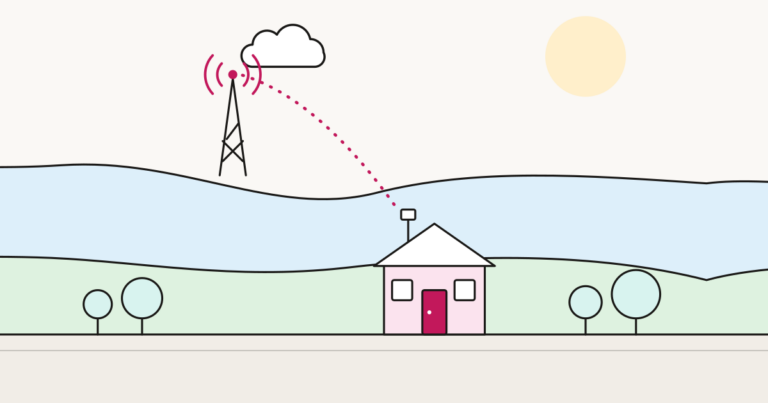
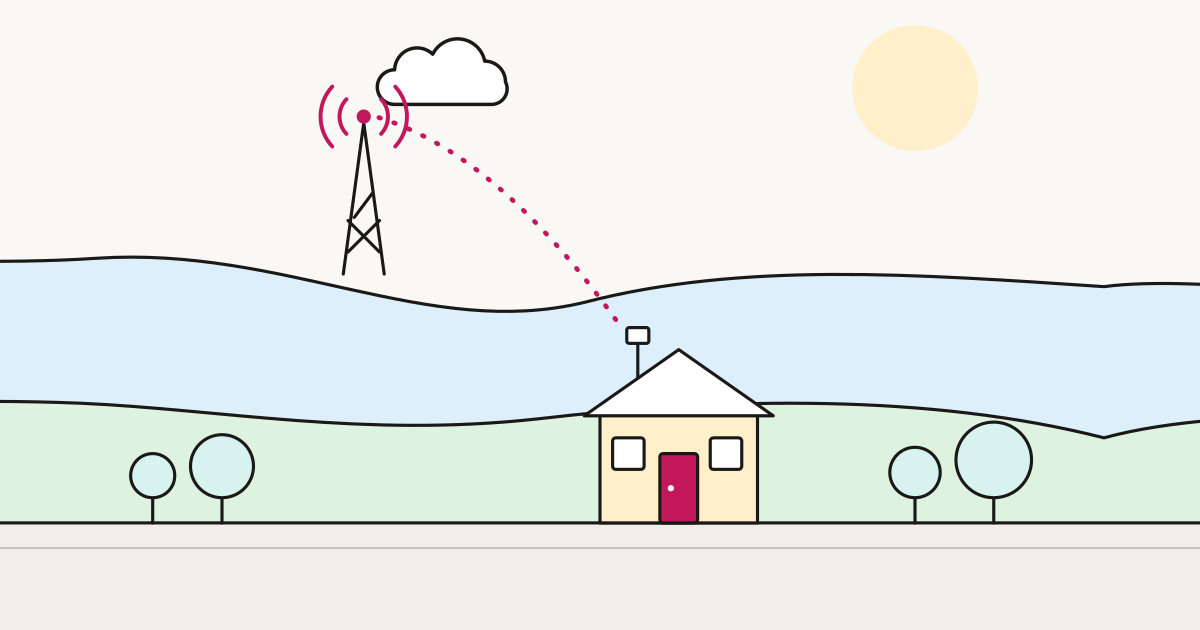
A router with a SIM card in it, connecting to the same masts your phone uses. No engineer, no phone line, no digging, no landlord permission: it arrives by post and works within an hour. For most people with no fibre this is the first thing to try, because trying it costs almost nothing if you use the money-back window properly.
What it costs, with the rises spelled out
Ofcom’s General Condition C1, in force since 17 January 2025, bans inflation-linked and percentage mid-contract rises in new consumer contracts. Rises are still allowed — but only as a fixed amount in pounds and pence, disclosed before you sign along with the exact date it takes effect. That is why the table below can exist at all. Every figure below is taken from the providers’ own sites in August 2026.
| Provider | Contract | Starting price | Rises to | Then |
|---|---|---|---|---|
| Vodafone 5G | 24 months | £18.00/mo | £21.50 on 1 Apr 2027 | £25.00 on 1 Apr 2028 |
| Vodafone 5G | 12 months | £22.00/mo | £25.50 on 1 Apr 2027 | — |
| Vodafone 5G | 1-month rolling | £29–30/mo | — | — |
| Three | 24 months | £22.00/mo | £24.30 on 1 Apr 2027 | £26.60 on 1 Apr 2028 |
The headline price is not the price you pay. Sign the Vodafone 24-month deal in August 2026 and you pay £18 for eight months, £21.50 for twelve and £25 for the final four — £502 over the term, an effective £20.92 a month. Three’s equivalent comes to £574, or £23.92. That is our own arithmetic from the published steps, and it ignores Three’s advertised £200 switching credit, which changes things materially if you qualify.
Vodafone still applies a CPI plus 3.9% escalator to out-of-bundle charges, which C1 does not cover. Unlikely to bite on an unlimited home router, but the clause exists.
We do not sell mobile broadband and we have no commercial relationship with Vodafone or Three. Those two are here because they publish their price steps clearly and are the easiest to compare — order direct from the operator.
What speed you will actually get
Vodafone sells its 5G home broadband in two tiers, described as up to 80Mbps and up to 150Mbps. Note the phrasing. For fixed-line residential broadband, CAP and BCAP rules since 23 May 2018 require any numerical speed in an ad to be an average achievable by at least 50% of customers at peak — Ofcom defines peak as 8pm to 10pm — and labelled “average”, not “up to”. “Up to” is a much weaker claim: treat it as a ceiling, not an expectation.
National Broadband, a multi-network fixed wireless and satellite reseller, states that 5G broadband delivers average downloads between 80 and 210Mbps, and claims over 83% of UK properties can get 5G from at least one of the four networks. Both are a reseller’s own marketing figures with no published methodology behind them, so weight them accordingly. There is no independent UK measurement of 5G home broadband speeds we would put in front of you instead — which is itself the point of the next section.
The three things that actually decide it
None appear on the price page.
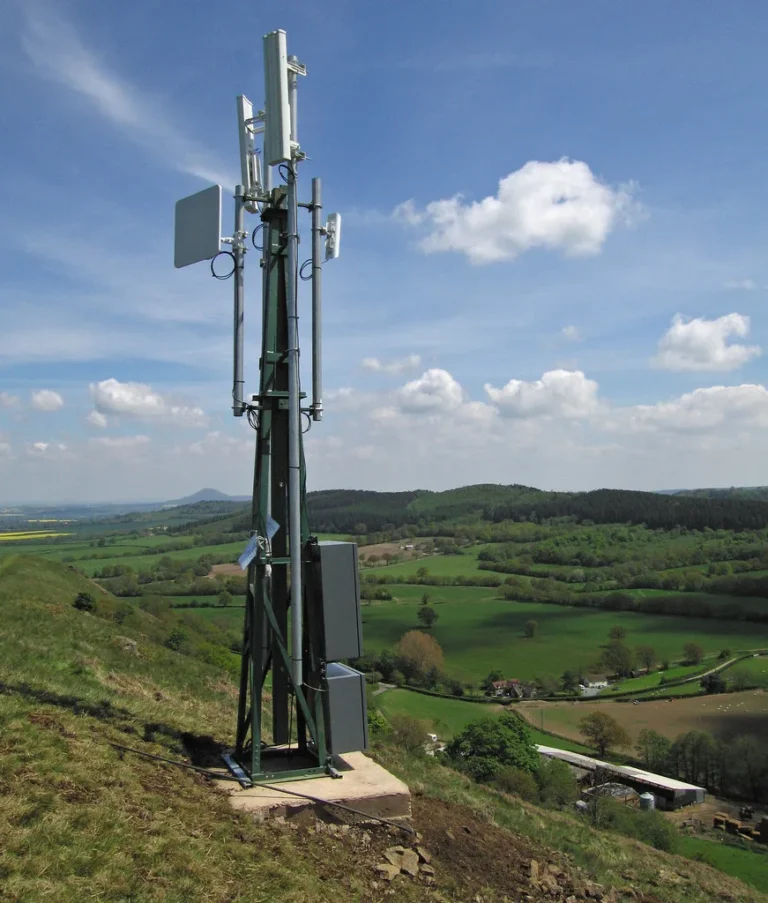
Distance and line of sight to the mast. Signal falls off fast, and 5G’s higher bands faster than 4G. A hill, trees or a stone wall between you and the mast matters more than the headline coverage tier.
Congestion. You share mast capacity with every phone nearby. A cell that tests beautifully at 11am on a Tuesday can be markedly slower at 8pm, and in tourist areas February and August look like different services.
Where you can physically put the router. The most underrated factor by a distance. A hub in a hallway cupboard performs far worse than the same hub on a first-floor windowsill facing the mast, and several providers support an external antenna. Find the mast, then find a socket near a window pointing at it.
How to check mobile coverage honestly
Operator coverage maps are predictive models, generated by the operator, describing their own network. They are not measurements and they are not neutral. Use them; do not trust them.
Ofcom’s Map Your Mobile checker is the closest thing to an independent view. Launched 26 June 2025, it covers 4G and 5G for EE, O2, Three and Vodafone, blending operator predictive data — modelled down to 50-metre squares — with crowdsourced real-world data from Opensignal, and it separates indoor from outdoor.
One limitation matters enormously in the countryside, and thinkbroadband flagged it at launch: the performance scores are averaged across the whole postcode district — the W12 in W12 7RJ — not your postcode. IV27, the largest district, covers around 1,393 square miles. A performance score averaged over that tells you almost nothing about your kitchen.
The 5G data gap worth knowing about
Ofcom also publishes a free coverage API for developers. Its specification rates 2G, 3G and 4G — voice and data, indoor and outdoor, per operator, on a 0–4 scale. There are no 5G fields in it.
So while Map Your Mobile does show 5G, there is no independent, address-level, machine-readable 5G coverage dataset for the UK. Every 5G coverage map you see on a comparison site or a provider’s page is built, at root, from what the operators say their own networks do. That does not make them useless. It means the right response to “5G available at your postcode” is not to sign for 24 months. It is to test it.
De-risk it with the money-back window
Three’s pay-monthly home broadband plans carry a 30-day money-back guarantee: if the signal or speed disappoints, return the hub and cancel for a full refund. Other providers offer similar windows — check the specific plan’s terms, because they vary and pay-as-you-go variants often differ.
Used properly this turns an unverifiable map into an experiment. Put the router where you intend to keep it and run speed tests over a full week, including 8pm to 10pm on a weekday, which is when it will be worst.
Option 2: fixed wireless from a WISP
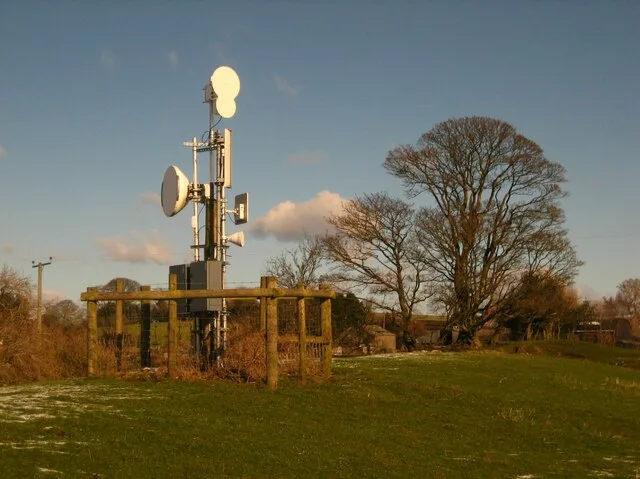
Distinct from mobile 5G, and often better. Wireless Internet Service Providers run their own masts and beam a dedicated link to a small dish on your house. Because the link is point-to-point and the operator controls capacity, a good WISP connection is far more consistent than a SIM sharing a public cell.
UKWISPA, the trade association, publishes a list of approved members running from community operators serving a single valley to full commercial networks. Voneus covers rural Central England, Northern England, the South West, Wales and the Isle of Arran; Quickline serves rural Yorkshire and Lincolnshire; Wildanet Cornwall and the South West; Airband rural England and Wales. Many now run a mix of fixed wireless and full fibre — Quickline, for instance, publishes both an FTTP and a fixed wireless footprint.
WISPs are excellent when you are within line of sight of a mast and useless when you are not — binary in a way mobile is not. Most survey for free, and the UKWISPA members list is the best starting point, because these operators are frequently invisible to national comparison sites.
One caveat: this end of the market is consolidating and retrenching. Freedom Fibre, FullFibre Limited, Voneus and Wildanet all exited Project Gigabit contracts between early 2025 and early 2026, citing delivery costs higher than they had assumed — Freedom Fibre gave up Cheshire in March 2025, FullFibre gave up West Herefordshire and the Forest of Dean, Voneus gave up Mid West Shropshire and Wildanet gave up Cornwall in February 2026. Airband announced further restructuring and redundancies in April 2026. Ask about contract length, and about what happens to your price and your service if the operator is acquired.
Option 3: satellite
Starlink works in the UK, is fast enough for most households, and starts at £40 a month for the Residential 100 Mbps tier as of July 2026. Ookla measured a UK median download of 106.63Mbps and 37ms latency in Q3 2025 — decent, though the UK is one of the slower Starlink markets in Europe, well behind Ireland’s 155.23Mbps.
It is also the most expensive option and it has had a volatile pricing year: the entry tier arrived at £35 a month in January 2026, went up £5 from June billing cycles, picked up a £10 monthly hardware rental for new residential customers in early June and then quietly lost it again around 18 July. Standby Mode doubled from £4.50 to £9 a month over the same period. And it is capacity-constrained. Starlink divides the country into cells with a finite subscriber ceiling; when a cell fills, the map shows “Waitlist” or “Sold Out” and new residential activations stop, with no timeline offered. Parts of the South East have been reported as sold out. Availability changes, so check the map for your own address rather than trusting anything written weeks ago.
It deserves more than a section here, and there is a separate piece on it. Treat it as the answer once fixed wireless has been ruled out by survey, not before.
Option 4: waiting — and whether that is realistic
“Fibre is coming” is something people are told for years. Here is how to check.
Ofcom’s Planned Network Deployments 2026 report compiles what operators say they will build over the next three years, from a January 2026 baseline: full fibre reaching 28.1 million homes (92%) by January 2029, gigabit coverage 29 million (95%). Rural gigabit coverage would go from 66% to 86% on the same timeline. These are operator plans, not commitments, they are national rather than address-level, and Ofcom itself brackets the gigabit figure between 93% and 95% depending on how much of the plan lands. Direction of travel, not a promise.
Project Gigabit is the government’s £5bn subsidy programme for premises commercial builds will not reach. Progress is real but slow: BDUK’s July 2026 update recorded 287,510 premises built to out of 838,490 contracted under Project Gigabit contracts, around 34%, with roughly 16,000 added in the month. Your local authority’s digital team will usually tell you whether your premises sit inside a contracted intervention area. Worth an email.
Gigabit vouchers are worth up to £4,500 per premises and are typically pooled across a community. The scheme is winding down: suppliers must register new voucher projects by 31 August 2026, most vouchers must be issued by 31 March 2027 (BDUK relaxed this slightly in June 2026 for suppliers with a strong delivery record), and all builds must complete by 31 March 2028. Starting a fresh project is effectively out of time; joining one an installer has already registered may not be, so ask. Openreach’s Fibre Community Partnership co-funds builds on the same principle, with Openreach paying what it can and the community funding the rest, often by pledging vouchers — though registrations have been paused at times due to demand.
Registering interest with altnets genuinely matters. Altnets use demand aggregation to set build order: they track registrations by zone and prioritise areas where enough households have raised their hands to make the economics work. A street with forty registrations gets built before one with two. If an altnet is building anywhere near you, get your neighbours to register.
Your legal backstop: the Universal Service Obligation
Every UK premises has a legal right to request a “decent” connection of at least 10Mbps download and 1Mbps upload. BT delivers this everywhere except Hull, where KCOM does. On Ofcom’s January 2026 data, roughly 39,000 UK premises could not get decent broadband from a fixed line or fixed wireless network, down from 44,000 six months earlier. Once satellite is counted, Ofcom puts the number without access to an affordable decent service at about 4,000 — a collapse driven almost entirely by Starlink’s price cuts, and the single most important thing to understand before you rely on the USO.
Two catches.
The cost threshold. The industry contributes up to £3,400 per premises. If BT’s survey comes back higher, you choose between paying the excess or declining. For remote properties that excess can run to tens of thousands. In its April 2026 biannual update BT reported USO connections built to 9,089 premises, up from 8,553 in October 2025, with 461 further builds in progress. Six years after the USO opened for requests, that is the scale of it: nine thousand homes, not ninety.
The 2026 change that matters most. In July 2026 Ofcom confirmed that Starlink meets the criteria for a viable alternative to the USO. BT is only obliged to build where no qualifying alternative exists — so applicants have reported USO requests being rejected on the grounds that Starlink is available at their address. The trigger was price: Starlink’s roughly £40 a month for the 100 Mbps tier fell below the USO affordability threshold of £59.60 a month. If you were counting on the USO, check Starlink availability at your postcode first. If it shows, expect a refusal.
The decision table
| Your situation | Best first move | Rough monthly cost (Aug 2026) |
|---|---|---|
| Good signal indoors, need it this week | 5G home broadband, rolling contract, commit later | £18–30 |
| Decent signal, want the lowest price | 5G home broadband, 24 months — check the rise steps | £18 rising to £25 (Vodafone) |
| Poor mobile signal, WISP mast in line of sight | Free survey from a UKWISPA member | Varies; often near fibre prices |
| No mobile signal, no WISP, need it now | Satellite — check your cell is not waitlisted | From £40 |
| Project Gigabit area with a build date | Wait; rolling 5G meanwhile | £29–30 rolling |
| Altnet building nearby but not to you | Register interest, recruit neighbours, rolling 5G meanwhile | £29–30 rolling |
| Nothing available at all, and Starlink shows no coverage | USO request to BT (KCOM in Hull) | Up to £3,400 of build cost covered |
| Nothing available, but Starlink can serve you | Expect a USO refusal; budget for satellite | From £40 |
In short: try 5G first because it is cheap to test and returnable; ask a WISP for a survey, because a good fixed wireless link beats a mediocre mobile one; keep satellite as the fallback; and register interest with every altnet within ten miles regardless of what you buy.
When fibre does arrive the pricing gap closes fast. Hey!Broadband, one example of altnet FTTP pricing in August 2026, lists 150Mbps at £23 a month, 400Mbps at £33 and 900Mbps at £43, with a free router and standard installation worth over £150. Its steps are disclosed the same way: the £23 tier holds until April 2027, then £25, then £27 from April 2028. Even after the rises that is far better value per megabit than any fixed wireless option, which is the whole reason waiting is sometimes right.
broadband.click focuses on full fibre, regional networks and rural availability. Some links on this site are affiliate links and we may earn a commission if you buy through them. This never affects which providers we cover or what we say about them. We do not compare the whole market — always check the provider’s own site for current prices before ordering.
Frequently asked questions
Is 5G home broadband good enough to replace fibre?
For most households, yes. A well-sited 5G router handles streaming, video calls and remote work comfortably. It is less consistent than fibre, because you share mast capacity with local phone users, and latency is higher. If you depend on large uploads, competitive gaming or several simultaneous heavy users, fibre remains clearly better.
How can I check 5G coverage at my exact address?
Use Ofcom’s Map Your Mobile checker, which covers all four networks and separates indoor from outdoor predictions. Then treat the result as a hypothesis, not a fact — operator coverage data is predictive modelling, not measurement. The only reliable test is ordering with a money-back guarantee, such as Three’s 30-day window, and running speed tests between 8pm and 10pm.
Can BT refuse my Universal Service Obligation request?
Yes, and increasingly does. BT is only obliged to deliver where no qualifying alternative exists. Ofcom confirmed in July 2026 that Starlink meets the criteria, and applicants have reported rejections on that basis. BT can also decline where the build cost exceeds the £3,400 industry contribution, unless you pay the excess yourself.
Does registering interest with a fibre provider actually do anything?
Yes. Alternative networks use demand aggregation to decide build order, tracking registrations by area and prioritising zones where enough households have signed up to justify the capital cost. One registration changes little; forty on a single street can genuinely move a build forward. It costs nothing and is the most effective action available to you.
What is the difference between 5G home broadband and fixed wireless from a WISP?
5G home broadband uses public mobile masts, so you share capacity with every phone nearby and performance varies with congestion. A WISP beams a dedicated point-to-point link from its own mast to a dish on your house. WISP links are usually more consistent but need clear line of sight, and most operators survey free.